 I am constantly shocked and reminded just how easy it is to hurt or be hurt by our loved ones due to problems of communication. Communication is supposed to consist of both talking and listening in somewhat equal measure. But regrettably, sometimes there is one but not the other. Sound familiar?
In some families, everyone seems to be talking but no one is listening. In others, members of a couple or family feel alone, left in the dark, because there is so little discussion or sharing. The truth is–healthy communication is much much more difficult than it seems at first glance.
 This is why when couples or families start therapy, improving communication is often the first goal. Without it, no problem can ever get solved. Few people have been taught the necessary skills, and many have picked up some pretty bad habits along the way. Most people, in fact, enter therapy quite convinced that they are already good communicators, only to discover that many of their skills are problematic or lacking.
Since effective communication seems so elusive–what are some of the most common mistakes all of us make?
 One of the most universal communication errors in our relationships with our parents, partners, and children is that we are tempted to speak without thinking first. This is understandable because we are typically less guarded with people we feel close to. The downside of having this increased freedom of expression is that we often blurt things that we would never even dream of saying out loud to a friend or colleague.
And then, to make matters worse, after having said something hurtful, tactless or even downright mean, we often make the further mistake of justifying what we’ve said rather than apologizing and owning up to the fact that we misspoke. (Here’s another blog on the problem of contempt in communication).
 Hence, Tip #1: Engage your brain before you open your mouth, and ask yourself if anyone will really be served by what you are about to say. The old adage “some things are better left unsaid” happens to be true. Healthy families are lavish when it comes to sharing positive words and more restrained and deliberate when it comes to delivering negative feedback.
The second most common error is that we assume that the other person actually understands precisely what we have communicated. Unfortunately, this is very often not the case. The best remedy for this (besides making your communications short and to the point) is to learn how to paraphrase and make a habit of asking the listener what they heard.
 This is especially useful when something important is being shared. If you are a parent and you want to make sure your child is listening, this is a helpful tool. (Or check out these songs for kids about talking and listening.) In our busy, multi-tasking complicated world, most adults also benefit from this practice when trying to talk to each other.
I know that this may sound incredibly tedious, boring, and unnatural–which it will be until you get better at it. Difficult as this may be at first, the great news is that it really works. Paraphrasing or “active listening” is an amazing tool that can prevent misunderstandings from blowing up into big fights or painful exchanges.
Precision of communication is important, more important than ever, in our era of hair trigger balances, when a false or misunderstood word may create as much disaster as a sudden thoughtless act. — James Thurber
 If you are the speaker, and from the look on your partner’s face, you can tell something has gone wrong, you can simply ask her what she just heard you say. This gives you a chance to correct things. If you are the receiver of a message, you can check out what you have heard by starting with “In other words, what you just said is…. or what you are wanting is…”
Hence, Tip #2: The more important the information being communicated, the more we need to slow down, taking ample time to make sure that the message we are sending is the same one that our loved one is receiving.
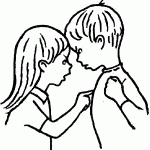 Another common mistake we often make when talking things over with our loved ones occurs when we believe that we are right and they are wrong. We get stuck in debate mode, and we begin to think more about our next response than about trying to listen and understand the other person’s point of view.
Both parties then become defensive and get locked into a position rather than trying to find common ground. Hence Tip #3: If you want to be right, carry on. If you want to feel close and connected, stop and listen as long as it takes to have some empathy or understanding for the other’s point of view.
Another glaring error is when we assume what someone is thinking or feeling rather than really listening. As  the old adage goes, to assume is to make an “ass” out of “u” and “me”. Many avoidable misunderstandings stem from the fact that we too quickly assume we know what the other person means.
Hence Tip #4: When speaking with your partner or your child, ask as many questions as you need to in order to understand where the other person is coming from. Don’t do all the talking yourself—ask questions and listen with an open heart and mind.
Since none of us will ever be perfect, we all need to know how to say we are sorry when we hurt someone’s feelings–whether we intended to or not. The whole point of communication is to strengthen our  relationships with others and with ourselves.
Keep the goal in mind and remember that mastery only comes with practice. Hence Tip #5 is to remember the power of apology and to practice it often. Try to remember to be loving and respectful in your choice of words, body language and tone of voice. And when you slip (which all humans do), learn how to take responsibility. “I’m sorry–that came out wrong.” or “Forgive me–I wasn’t listening to you–tell me again.” Trust me, it’s a lifelong learning. Start by simply slowing down and paying more attention. Go gently with yourself and others.

Ah yes…. Receptive listening…not new but still needed
Well said. Yes, so many fights and downward spirals begin simply because of ‘failures to communicate’. Slowing down and using reflective listening is pure magic …. it is amazing how often when people reflect back what they heard how OFF the mark it can be, and if they are actually able to hear what is really being said, so much pain and fighting can be stopped before it starts.
And of course, as you say, asking yourself the question, do you want to be right or do you want to be close is vital. I find that waiting until both people are ready and want to be close, to actually even try to talk, is really helpful.
Thanks for this post. Really helpful info!
~inspired girl aka Barbara
http://www.inspiredgirl.me